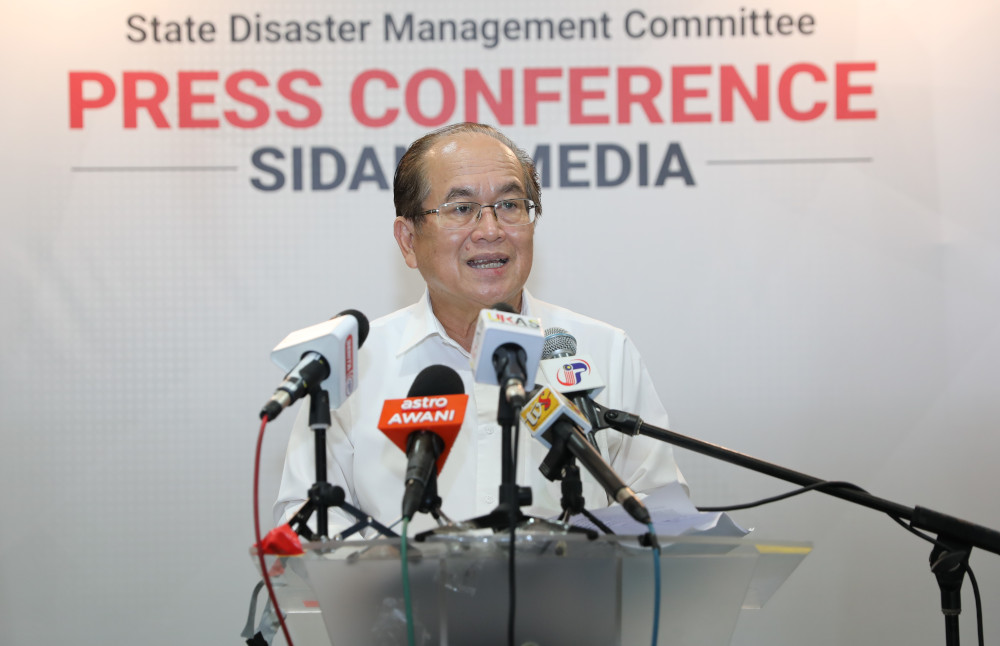
KUCHING, March 4 — Foreign workers will be allowed back into Sarawak from March 1 but under stringent standard operating procedure (SOP) to prevent the spread of Covid-19, State Disaster Management Committee (SDMC) chairman Datuk Amar Douglas Uggah Embas said.
He said the reopening of the state to foreign workers was decided during a meeting chaired by Chief Minister Datuk Patinggi Abang Johari Tun Openg this morning.
“This decision was made due to the many requests from industries that require foreign workers,” Uggah, who is also a deputy chief minister, told a Covid-19 situation update press conference here.
Uggah pointed out that a ‘State Localisation Committee’ had approved a total of 27,000 applications for foreign workers covering sectors like agriculture, plantation, construction, manufacturing and services.
Sarawak had stopped the entry of foreign workers last year due to the pandemic.
Uggah also emphasised today that the recruitment of foreign workers was subject to Covid-19 SOP drawn up by the Immigration Department and approved by SDMC.
“First, the workers must get their Covid-19 test done in their home countries three days before departing.
“When they reach Sarawak, the employer is responsible to pick them up from the point of entry and then bring them to a place of quarantine. If for plantation, can be at the plantation. But the place of quarantine must be approved by the State Health Department,” he said.
He said employers who did not have a quarantine centre can put their workers at designated hotels for 14 days.
“The workers will be tested on the second and tenth days. All costs are to be borne by the employer.
“After they have completed the quarantine then they can go to the plantation or their workplace. It is a very strict and stringent SOP,” he said.
Uggah noted that as the numbers are quite high, he had asked State Health director Dr Chin Zin Hing to work out a schedule for the workers’ entry.
“This is to ensure the capacity of testing in Sarawak will be sufficient. We don’t want to create a backlog and bottleneck in the system.
“We will make sure that the process is seamless and we need the cooperation of everyone,” he said. — Borneo Post
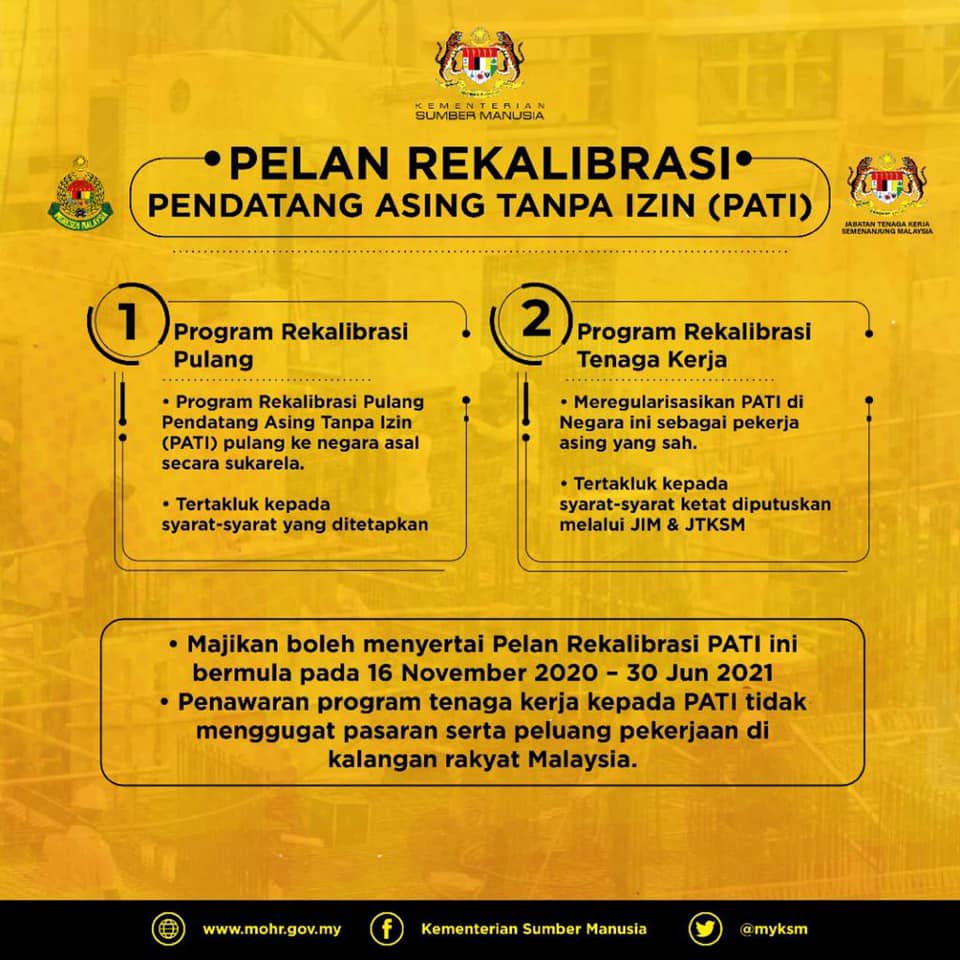
Kerajaan Malaysia melancarkan Pelan Rekalibrasi Pendatang Asing Tanpa Izin (PATI) merangkumi dua komponen utama
1) Program Rekalibrasi Pulang dan
2) Program Rekalibrasi Tenaga Kerja
yang akan dilaksanakan bermula 16 Nov 2020 hingga 30 Jun 2021 kepada pendatang tanpa izin yang ada di negara ini.
Menteri Dalam Negeri Datuk Seri Hamzah Zainudin berkata Program Rekalibrasi Pulang merupakan program yang membenarkan PATI untuk pulang ke negara asal secara sukarela tertakluk kepada syarat-syarat tertentu yang ditetapkan.
Program Rekalibrasi Tenaga Kerja pula menjadikan PATI yang ada di negara ini sebagai pekerja asing yang sah, digajikan oleh majikan yang layak, tertakluk kepada syarat ketat yang diputuskan oleh kerajaan melalui Jabatan Imigresen Malaysia dan Jabatan Tenaga Kerja Semenanjung Malaysia, katanya.
“Kita masih membeku kemasukan pekerja asing baharu ke Malaysia dan ia masih diteruskan.
“Pelan ini adalah untuk pendatang tanpa izin dalam negara dan jika mereka ingin bekerja secara sah boleh, dan kalau ingin pulang ke negara asal juga boleh. Kita beri tempoh sehingga 30 Jun,” katanya ketika melancarkan Pelan Rekalibrasi PATI itu di Kementerian Dalam Negeri, di sini hari ini.
Hamzah berkata Pelan Rekalibrasi PATI itu akan dilaksanakan oleh Jabatan Imigresen (JIM) dengan kerjasama strategik Jabatan Tenaga Kerja Semenanjung Malaysia (JTKSM) serta agensi-agensi kerajaan yang lain tanpa penglibatan vendor atau pihak ketiga.
Menerusi pelan itu Hamzah berkata kerajaan dijangka memperoleh kutipan hasil sebanyak RM95 juta daripada kompaun serta bayaran lain yang dikenakan terhadap pendatang tanpa izin dan majikan.
“Dalam landskap ekonomi yang tidak menentu akibat penularan pandemik COVID-19, kerajaan telah membuat timbang tara yang strategik terhadap pelan ini dengan menilai kesan positif serta kesan negatif pelaksanaannya,” katanya.
Pertimbangan turut diberikan dari aspek keperluan untuk mengumpulkan data taburan serta demografi PATI di Malaysia bagi tujuan penguatkuasaan yang menyeluruh seperti digariskan dalam Pelan Holistik Penguatkuasaan PATI yang diperkenalkan kerajaan sejak awal tahun ini.
“Pendataan PATI boleh diselaraskan melalui maklumat yang dikemukakan oleh PATI dan majikan semasa pendaftaran program ini,” katanya.
Hamzah memberi jaminan penawaran program tenaga kerja kepada PATI sedia ada di Malaysia tidak akan menggugat pasaran serta peluang pekerjaan dalam kalangan rakyat tempatan.
“Peluang pekerjaan kepada pekerja tempatan adalah terjamin tertakluk kepada dasar penetapan nisbah pekerja tempatan dan pekerja asing yang berkuat kuasa ketika ini,” katanya menambah kerajaan sentiasa mengutamakan rakyat tempatan bagi mengisi kekosongan tenaga kerja dalam semua sektor ekonomi.
Menjelas lanjut, Hamzah berkata empat sektor iaitu pembinaan, perkilangan, perladangan dan pertanian dibenarkan mengambil pendatang tanpa izin untuk bekerja dalam tempoh pelaksanaan Pelan Rekalibrasi PATI.
“Buat masa ini, hanya majikan yang beroperasi dalam empat sektor yang bersifat 3D iaitu dangerous, difficult dan dirty (kotor, bahaya dan sukar) dibenarkan untuk mengambil PATI sebagai pekerja,” katanya sambil menambah pelan itu hanya untuk PATI dari 15 negara sumber seperti Thailand, Kemboja, Nepal, Myanmar dan Bangladesh.
Hamzah berkata satu Jawatankuasa Pemandu Pelaksanaan Pelan Rekalibrasi PTI telah ditubuhkan dengan diketuai oleh Ketua Setiausaha Kementerian Dalam Negeri (KDN) Datuk Wan Ahmad Dahlan Abdul Aziz.
Jawatankuasa itu dianggotai oleh pelbagai agensi seperti Kementerian Sumber Manusia (KSM), JIM, JTKSM serta beberapa agensi berkaitan yang berperanan untuk memantau dan mengawal selia pelaksanaan Pelan Rekalibrasi PATI.
Jawatankuasa Khas peringkat menteri itu turut membincangkan keperluan untuk meluaskan Pelan Rekalibrasi PATI kepada sektor-sektor lain kelak dan dasar berkaitan ekspatriat. Mesyuarat pertama jawatankuasa ini dijadualkan pada 3 Dis 2020, katanya.
KDN dan KSM bersetuju untuk mengintegrasi dan berkongsi data bagi menguruskan hal ehwal pekerja asing termasuklah penyeragaman pembayaran gaji melalui satu system e-wages yang sama dan perkara itu akan dibincangkan dalam mesyuarat jawatankuasa khas peringkat menteri akan datang, katanya.
“Majikan wajar mengambil peluang pelaksanaan pelan ini untuk mendaftarkan PATI sedia ada di negara ini sebagai sumber tenaga kerja di semua sektor ekonomi yang terlibat,” kata Hamzah.
Turut hadir ialah Menteri Sumber Manusia Datuk Seri M. Saravanan dan Ketua Pengarah Imigresen Datuk Khairul Dzaimee Daud.
KUALA LUMPUR, MALAYSIA – Malaysia is edging toward a new deal with Bangladesh to lift a ban imposed on migrant workers from Bangladesh more than a year ago over concerns that recruitment agencies were driving them into forced labor.
Rights advocates are hopeful but wary that the deal being negotiated will break up the “syndicate” they accuse of monopolizing the labor pipeline at the migrant workers’ expense.
Malaysia stopped allowing Bangladeshi migrant workers into the country in September 2018 amid mounting news reports that only 10 recruitment agencies from among hundreds in Bangladesh were being allowed to send workers to Malaysia. They were being accused of driving up the costs of landing a job to $5,000, forcing the workers to take on crippling debts that all but enslaved them to their recruiters or employers.
A joint statement issued by both countries on Nov. 6 said they expected to amend a 2016 memorandum of understanding that established the labor pipeline by the end of the month.
But Amir bin Omar, secretary general of Malaysia’s Human Resources Ministry, said tentative plans to sign a deal on Tuesday, and for another joint meeting on Sunday to set a date to lift the ban, would likely be postponed because the details had yet to be settled.
Omar said the ministry has also decided that it wants the full Malaysian Cabinet to approve the deal before the two countries meet, rather than after, but still expects that it will be signed by early December.
“They’ve almost agreed, almost 90 percent. It’s just a little bit [left]. Better to get approval from the Cabinet; I don’t know when. We will try to do it as soon as possible,” Omar said.
“We are talking about who has to [pay], the employer or the employee, how much; that is the thing we need to discuss in detail,” he added.
Omar said migrant workers would very likely still have to cover some of the costs, such as their travel. But he added that Malaysia was intent on taking most of the financial burden off their backs and to open up the recruitment process to more agencies.
FILE – Workers are searched by security guards as they leave a construction site in a Kuala Lumpur suburb, Malaysia, March 23, 2010.
“We want to leave it open to the market, but that is subject to our discussions with Bangladesh,” he said.
Bangladesh’s minister of expatriates’ welfare and overseas employment, Imran Ahmad, declined to speak with VOA over the phone and did not reply to requests for comment by email.
Bangladesh’s economy relies on remittances from its migrant workers as much as Malaysia’s depends on migrant workers from Bangladesh and elsewhere to fill its factories and plantations.
Malaysia officially claims to host 1.7 million migrant workers, but the International Labor Organization says the true figure, including many here illegally, may reach 4 million — nearly a third of the country’s workforce. Bangladeshis make up anywhere from 200,000 to 400,000 of them.
Andy Hall, a migrant worker rights specialist based in Asia, said Malaysia and Bangladesh were both under pressure to strike a better deal for the workers.
The United States banned imports from Malaysian rubber gloves maker WRP Asia Pacific in October over suspicion that its factories were using forced labor, and Hall said other factories in the country were at risk of similar sanctions. Bangladesh was placed on the Tier 2 Watch List in the U.S. State Department’s latest Trafficking in Persons Report for the third year running, one step above Tier 3, where it could come under trade sanctions itself.
“So they’re quite tense,” Hall said. “It’s clear that, I think, it’s going to be a lot better than in the past because everyone’s focusing on this now after the last scandal, when workers were … having to pay up to $5,000 each.”
Joseph Maliamauv, co-director of Malaysian rights group Tenaganita, hopes the new deal will benefit Bangladesh’s migrant workers but is skeptical.
“Migration is seen as big business; this commodification of migrants and migration. So there is a lot of money to be made there, and it’s going to take a lot of effort to get people to not take advantage of that,” he said.
“I hope that the costs can be reduced, but I will not be holding my breath until I see the results…Because I don’t see very much changes in anything else in regard to migration, the way immigration is being handled.”
Tenaganita said it would prefer to see the Malaysian government wrest back control of the migrant labor pipeline from the private sector but that the same companies it outsourced the process to remain in charge, leaving the migrants at risk of profit-driven fleecing.
In 2018, Nepal barred its nationals from going to Malaysia to work after accusing the Malaysian companies contracted by their government to process the applications of charging extortionate fees.
Hall said Nepalis started arriving in Malaysia again in September under a new deal in which the costs were placed on employers. But he said some of the new arrivals he has met in Malaysia claim that they are paying many of the same old fees under the table.
It may be too early to say whether their deal will end up working as intended, Hall said, “but the indications are that there are major challenges in enforcing it and…that the kickbacks culture, the corruption that has gone on for so long is still there. It hasn’t gone anywhere.”
Bangladesh-Malaysia Joint Working Group (JWG) meeting scheduled to be held in Dhaka on Tuesday was deferred following a request from the members of Malaysian team.
However, the new schedule has not yet been fixed. It will be finalized later with the consent of Malaysian members. The meeting is likely to be held in next October this year.
Although the JWG’s Dhaka meeting was deferred, another bilateral meeting between Expatriate Welfare and Overseas Employment Minister of Bangladesh Imran Ahmed and Human Resources Minister of Malaysia M Kulasegaran will be held at Putrajaya in Malaysia at the scheduled time of JWG meeting.
To hold the meeting with Malaysian Minister, a five-member Bangladesh delegation led by the Expatriate Welfare Minister will visit Kuala Lumpur from September 25 to 28 this year.
According to the officials, the delegation will finalize a draft of memorandum of understanding (MoU) with the procedures and terms of references (ToR) for recruiting Bangladeshi workers to the country.
The MoU will be signed later for sending Bangladeshi migrants there.
When contacted, Expatriate Welfare and Overseas Employment Minister Imran Ahmed told this correspondent on Monday at his office that the meeting was deferred following Malaysian delegation’s request.
The last meeting of the JWG was held in Putrajaya this year. According to the provision, the next meeting of the JWG will be held in Bangladesh. But, they haven’t yet given a new schedule. It would be held in a convenient time later, he added.
Regarding Putrajaya visit of Bangladesh delegation, he said Bangladesh is ready for the visit. The delegation will start for Malaysia soon.
The bilateral meeting will finalize the draft of the MoU, which would be signed later. Following the ToR of the agreement, Bangladeshi migrants will be sent to the country for overseas employment.
“Once the agreement is signed and necessary mechanisms are finalized, Bangladesh will start sending migrants there following their requirements. We will send workers – skilled, semi-skilled and professional – following their demands,” he added.
According to the ministry sources, Director General of Bureau of Manpower Employment and Training Selim Reza, ministry’s Additional Secretary Ahmed Munirus Salehin, Joint Secretary Fazlul Karim and Deputy Secretary Mohammad Abul Hossain will accompany the minister at the meeting as members of the delegation.
In last August, a Malaysian delegation held a series of meetings with the Bangladeshi officials concerned to finalize the draft of policies and guidelines on recruiting Bangladeshi workers.
The Malaysian government had suspended its previous recruitment system and announced a plan to stop hiring Bangladeshi workers under a new scheme last year.
According to the ministry officials, Malaysian government is not interested to hire foreign workers through any syndicate.
It wants a fair competition in hiring workers from Bangladesh through all approved recruiting agencies. The minister may give signal for ‘no syndication’ during his visit.
Malaysia offered Bangladesh to send more than 500,000 Bangladeshi nationals for different sectors in 2016.
The two countries had signed a memorandum of understanding in which Malaysia agreed to recruit workers from Bangladesh for five different sectors under the ‘government-to-government plus’ system.
Although the agreement was signed to send more than five lakh workers to the country in a year, Bangladesh could not send two lakh workers in two years due to a syndicate of 10 Bangladeshi recruiting agencies and its Malaysian agent.
But the Malaysian government said the whole process was ‘a total mess’ and it resulted in the migrant workers paying excessive amounts of money to middlemen in both countries.
Source Info : https://www.observerbd.com/details.php?id=219178
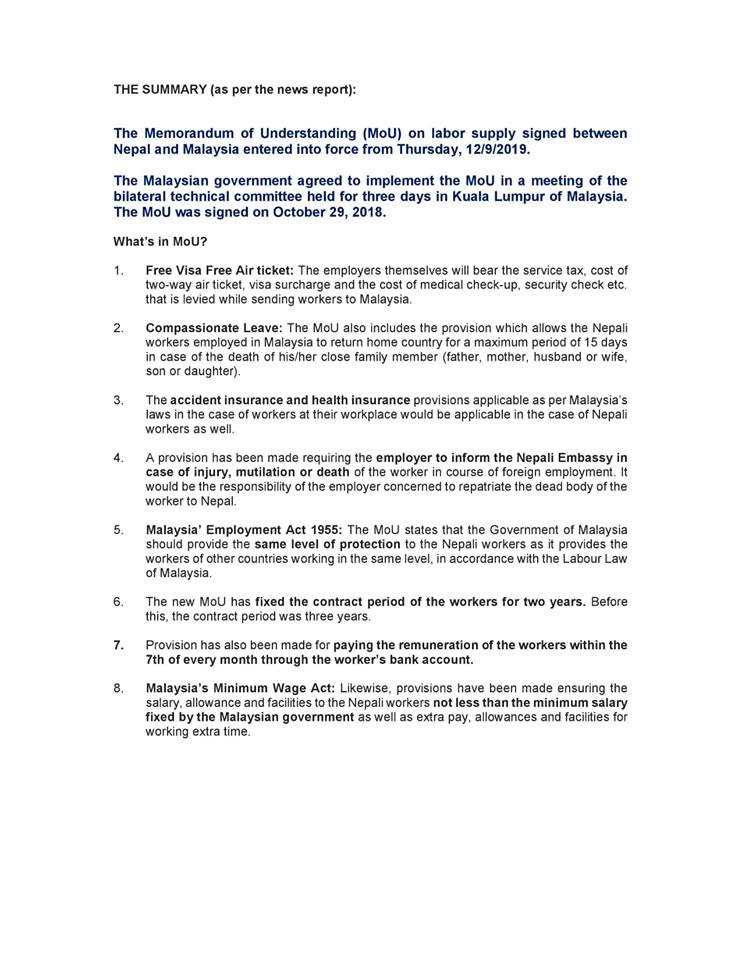
KATHMANDU: A Memorandum of Understanding (MoU) on labor supply earlier signed between Nepal and Malaysia entered into force from Thursday.
The Malaysian government agreed to implement the MoU in a meeting of the bilateral technical committee held for three days in Kuala Lumpur of Malaysia. The meeting concluded today. The MoU was signed on October 29, 2018.
Senior joint-secretary at the Ministry of Labour, Employment and Social Security, Dr. Ram Prasad Ghimire who headed the Nepali delegation in the meeting said that the MoU officially entered into force from today with the Malaysian Government being agreed in writing to hire Nepali workers as per the MoU.
In accordance with the new provisions, all cost required to recruit Nepali migrant workers will be borne by employers and aspiring workers need not pay any charge for the same.
The MoU was in pending due to lack of willingness on the part the Malaysian government to implement it. The Malaysian government seemed not interested in summoning the meeting of the technical committee which had first met in Kathmandu. Joint Secretary Ghimire headed the Nepali team in the meeting while the Malaysian party was led by Betty Hasan, Chief of Policy Division of Human Resources Development Ministry there.
It may be noted that Nepal has already sent a list of 122 health institutions eligible for carrying out medical tests of aspiring Nepali workers to Malaysia as per the standard set by the latter.
What’s in MoU?
As per the MoU, the employers themselves will bear the service tax, cost of two-way air ticket, visa surcharge and the cost of medical check-up, security check etc. that is levied while sending workers to Malaysia. Provision has been made for not charging the additional charge that was taken from the Nepali workers.
The MoU also includes the provision which allows the Nepali workers employed in Malaysia to return home country for a maximum period of 15 days in case of the death of his/her close family member (father, mother, husband or wife, son or daughter).
The accident insurance and health insurance provisions applicable as per Malaysia’s laws in the case of workers at their workplace would be applicable in the case of Nepali workers as well.
A provision has been made requiring the employer to inform the Nepali Embassy in case of injury, mutilation or death of the worker in course of foreign employment. It would be the responsibility of the employer concerned to repatriate the dead body of the worker to Nepal.
The MoU states that the Government of Malaysia should provide the same level of protection to the Nepali workers as it provides the workers of other countries working in the same level, in accordance with the Labour Law of Malaysia.
The new MoU has fixed the contract period of the workers for two years. Before this, the contract period was three years. Provision has also been made for paying the remuneration of the workers within the 7th of every month through the worker’s bank account.
Likewise, provisions have been made ensuring the salary, allowance and facilities to the Nepali workers not less than the minimum salary fixed by the Malaysian government as well as extra pay, allowances and facilities for working extra time.
Source from : https://english.khabarhub.com/2019/12/43871/?fbclid=IwAR2DT–1vHspG1G9CVgWI8NiyiUa_4tPctdGzeMmYBN5jPNr2L0cqjED-jU
A Malaysian team will arrive in November to inspect medical facilities, which is expected to restart labour migration to the Southeast Asian country.
A new agreement between Nepal and Malaysia is expected to pave the way for the resumption of labour migration to the Southeast Asian country.
Migration to Malaysia for work has remained suspended since May 2018. According to Thursday’s agreement, signed between a visiting Nepali delegation and Malaysian officials from the Ministry of Human Resources in the Malaysian city of Putrajaya, a Malaysian team will soon arrive in Kathmandu to inspect health facilities conducting medical examinations of Nepalis aspiring to work in the Southeast Asian country.
The Malaysian team will be visiting Nepal in early November, according to Ram Prasad Ghimire, joint-secretary at the Ministry of Labour, Employment and Social Security.
“This is a significant development in implementing the memorandum of understanding reached between the two countries in October 2018,” Ghimire, who is leading the Nepali delegation to Putrajaya, told the Post over the phone.
The October agreement between Nepal and Malaysia had relieved Nepali workers of all expenses, including recruitment service charges, airfare, visa fees, medical check-ups and security screening costs, all of which Malaysia-bound workers were required to pay earlier. But the agreement has yet to be implemented due to various hurdles, including one related to the medical examination of outbound workers.
“Since the labour deal, a joint technical committee consisting of officials from both countries had not met. Finalising medical facilities was the topmost agenda of the meeting,” said Ghimire.
According to the agreement, the Malaysian team will inspect 86 health institutions—out of 122 enlisted by the Nepal government—to include them on a list of authorised medical examination facilities.
Earlier, only 36 health institutions selected by the Malaysian side were mandated to conduct medical examinations of Nepalis aspiring to work in Malaysia, which had given rise to a monopoly.
The departure of new Nepali migrant workers to Malaysia had remained suspended since the government launched a crackdown on a syndicate offering various pre-departure services to Malaysia-bound workers. Both countries then had to appoint new health facilities, work on which began only after the Malaysian side forwarded its medical examination standard in March, five months after the signing of the labour agreement in Kathmandu.
The prolonged delay in the reopening of Malaysia has been criticised by recruitment agencies and the opposition parties as a failure of the government. Many feared that Nepal would forever lose its most popular labour destination.
Malaysia’s closure was also reflected in the country’s foreign employment sector as the number of workers migrating abroad dwindled significantly last year. In the fiscal year 2018-19, only 42,146 Nepali workers left for work in Malaysia.
While workers with calling visa had been allowed to take up jobs, migration of new workers has remained stalled for months now. A lack of confusion about the status of departure to Malaysia had also resulted in instances where Nepali workers were duped by recruiting agencies.
“With today’s agreement, the process of sending Nepali workers as per the labour deal has begun,” said Ghimire. “Our aim was to provide zero investment jobs to our workers, which we have secured. Departures will now take place accordingly.”
Source info from : https://kathmandupost.com/national/2019/09/12/nepal-signs-deal-to-pave-the-way-for-the-resumption-of-labour-migration-to-malaysia
KATHMANDU, Aug 30: Nepal and Malaysia have reached closer to an agreement to resume sending workers from Nepal after a hiatus of some 14 months.
A seven-member Nepali delegation from the Ministry of Labor is visiting Kuala Lampur for negotiation scheduled for September 10-11 after the Malaysian authorities positively responded to Nepal’s demand concerning medical centers where prospective workers from Nepal undergo health checkup prior to their departure.
A note verbale sent by the Embassy of Malaysia in Kathmandu to the Ministry of Foreign Affairs on Tuesday said they would consider all 122 medical centers proposed by the Nepal government to perform BMS screening process for recruitment to Malaysia “in the future as long as they fulfill the criteria and requirements set by the Malaysian government.”
Spokesperson for the Ministry of Labor, Employment and Social Security, Narayan Prasad Regmi said they are in favor of resuming the process to send workers to Malaysia. “The rest of the things will be clear once we hold negotiation with the Malaysian side,” he said.
The Malaysian government has recognized only 36 of the total 122 medical centers proposed by Nepal to conduct any such test now. “… the 36 medical centers will continue to perform the BMS screening process for recruitment to Malaysia on the basis that these medical centers have been equipped with BMS; have been audited annually by the Government of Malaysia through the Embassy of Malaysia and Bestinet Sdn Bhd and have been certified by the Ministry of Health of Nepal and Ministry of Labor, Employment and Social Security of Nepal to conduct medication examination on Nepali going abroad for work,” said the Note Verbale.
The Malaysian side has expressed hope that the new arrangement would pave the way for resuming the process to send workers from Nepal to Malaysia. “The Government of Malaysia is of the view that the decision will ensure no further delay to the resumption of recruitment process to Malaysia that continue to be suspended by the Government of Nepal even after the signing of a Memorandum of Understanding between the government of Malaysia and the Government of Nepal on the Recruitment, Employment and Repatriation of Workers on 29 October 2018,” the note further said.
Malaysia is one of the largest labor destination countries for Nepal, with about 1.1 Nepali workers currently working there. Around 130,000 Nepali workers go to Malaysia for work each year.
PETALING JAYA: Several laundry operators have urged the government to reconsider its decision to ban the hiring of foreign workers for the laundry and textile sub-sectors.
Zarina Ismail, who owns the Drop and Wash chain of laundry shops and claims to speak for the Malay Unified Laundry Association and Selangor and Kuala Lumpur Laundry Association, said the ban would cripple the business.
Zarina, a lawyer, is advising the two associations, which are trying to work with the government to resolve the issue.
She said the moratorium on foreign workers, which stretches from this year until 2021, did not correspond with the reality of a “multibillion-ringgit industry”.
“The government is a little out of touch with the industry,” she told FMT. “It has told us that everybody can do laundry, which is not the case.
“We service hotels, airlines, the government and the retail business, all of which have different textile needs. It’s not just wash, dry, and fold.”
She said there was a high demand for workers but a shortage of supply among locals.
“It’s the same with mamak stalls. Locals don’t want to work these jobs. We have the best equipment, but they leave after a while.
“Our customers have hundreds of workers and thus require tonnes of laundry to be cleaned. I myself run a business with shops that clean a thousand shirts a day.”
She said locals were unwilling to go through the long hours of training necessary for employment in professional textile care even though most of the businesses had comfortable workplaces and paid wages above the market rate.
“We pay a minimum wage of RM1,500 for an SPM holder,” she said.
“Even though we work with Socso and civil society groups to source local workers, even from the disabled community, it is not enough.
“The foreigners stay longer, and they are not cheap either. If you want good workers, you cannot pay peanuts.”
Zarina said the government should allow laundry operators to resolve employment issues on a case-by-case basis.
“We need foreign workers at the end of the day,” she added.
“The government is a little out of touch with the industry,” she told FMT. “It has told us that everybody can do laundry, which is not the case.
“We service hotels, airlines, the government and the retail business, all of which have different textile needs. It’s not just wash, dry, and fold.”
She said there was a high demand for workers but a shortage of supply among locals.
“It’s the same with mamak stalls. Locals don’t want to work these jobs. We have the best equipment, but they leave after a while.
“Our customers have hundreds of workers and thus require tonnes of laundry to be cleaned. I myself run a business with shops that clean a thousand shirts a day.”
She said locals were unwilling to go through the long hours of training necessary for employment in professional textile care even though most of the businesses had comfortable workplaces and paid wages above the market rate.
“We pay a minimum wage of RM1,500 for an SPM holder,” she said.
“Even though we work with Socso and civil society groups to source local workers, even from the disabled community, it is not enough.
“The foreigners stay longer, and they are not cheap either. If you want good workers, you cannot pay peanuts.”
Zarina said the government should allow laundry operators to resolve employment issues on a case-by-case basis.
“We need foreign workers at the end of the day,” she added.
PETALING JAYA: Growth of the construction industry is currently at a worrying state given the lack of jobs in hand to ensure its continuity, affecting its contribution to the economy.
The Master Builders Association Malaysia (MBAM) has appealed to the government to speed up contract awards, especially for big projects such as the second phases of the Pan Borneo Sabah and East Coast Rail Link.
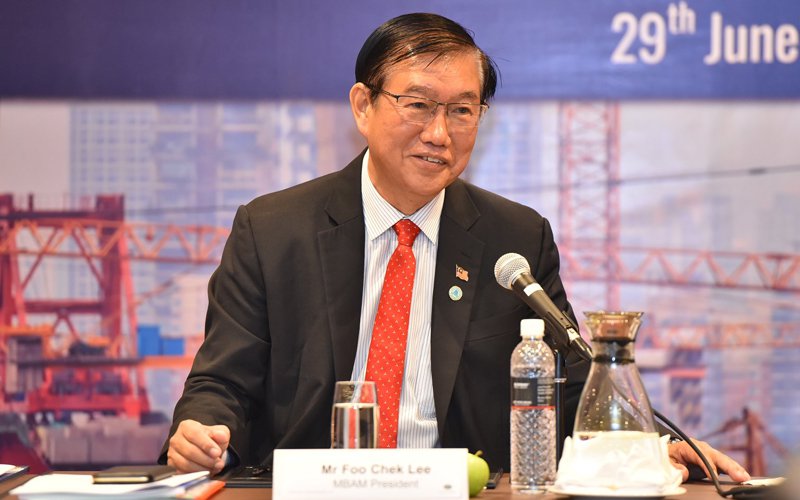
MBAM president Foo Chek Lee said contractors had been eagerly waiting for jobs for these projects.
He said many contractors had expressed concern and “hunger” for new jobs as most existing projects would be completed by the year-end or in mid-2020.
He said even if the government is facing some financial issues at the moment, small projects could be awarded and their implementation extended to a longer period.
“This, at least, will enable small contractors to keep going. The industry will stall if they are jobless,” he told a press conference after officiating the MBAM Affiliate Dialogue 2019 here today.
Foo said the sustainability concern was raised mostly by small and medium enterprises as the “big boys” could avoid this problem by securing overseas projects.
The association also appealed to the government to simplify the process of approval to bring in foreign workers as the current process, involving 26 procedures compared to only one in Singapore, was very time-consuming.
This creates a hurdle for the contractors to meet the project deadlines, while facing a worker shortage, Foo said.
He said a number of the applications for workers were rejected due to minor errors, such as typos and auditing hiccups that could easily be rectified.
On the minimum standard of accommodation for workers, Foo said MBAM’s members were willing to cooperate with the government and ready to implement the rules if they were regulated.
He said the budget would be calculated under the preliminary cost, which in turn might have an impact on end-products.
This, however, could be reduced with government help in terms of land subsidy, as well as a lower percentage of compliance cost and tax, he added.
All Copyright Reserved Agensi Pekerjaan Covey Integriti Sdn Bhd